

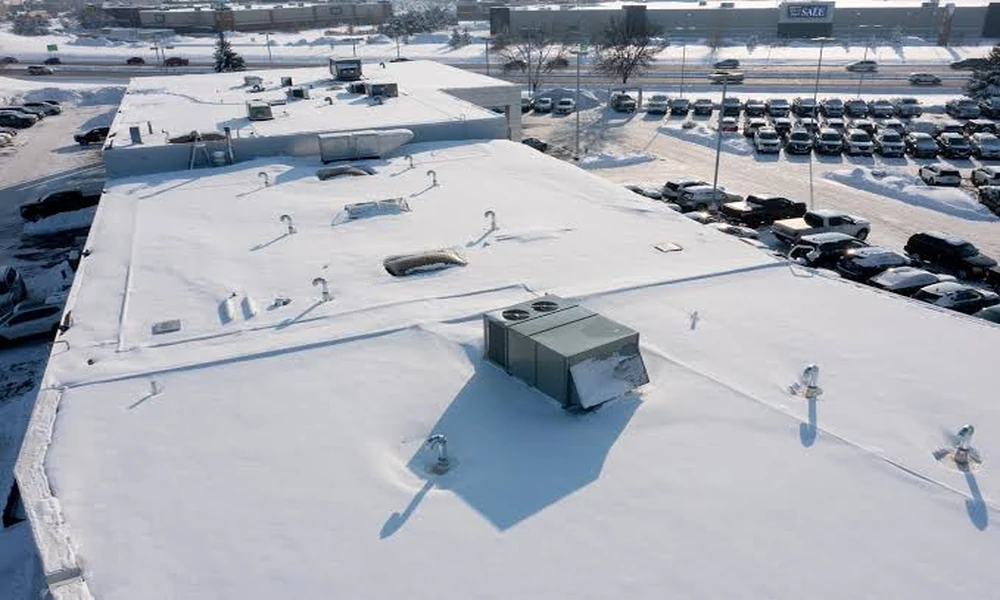
For decades, most low-slope commercial roofs around the Las Vegas Valley were managed the same way. Nobody went up until water dripped onto a tenant’s desk. A crew patched the obvious spot, and the roof was forgotten until the next storm. That routine fit the simple gravel roofs of the past far better than it fits today’s. Single-ply membranes, reflective coatings and crowded rooftop equipment have changed what a roof needs, and longer triple-digit stretches turn small defects into expensive ones faster.
That shift is why more property managers and building owners now hand their roofs to a contractor that treats maintenance as a program instead of an emergency phone number. Vegas Born Roofing, a Las Vegas contractor licensed in Nevada, Utah and Arizona, pairs scheduled inspections and budget-friendly maintenance plans with an in-house sheet metal shop that fabricates its own flashing, coping, scuppers and HVAC curbs, so a problem spotted on an inspection gets fixed with parts made for that exact roof. Owners from Henderson and Summerlin to Pahrump and Mesquite can request a free quote and move their roof from the crisis list onto a calendar.
What the old routine looked like
Inspection. A roof got looked at when it leaked or when a buyer’s due diligence report forced the issue. The person on the ladder was often an HVAC technician, not someone trained to read membrane seams.
Repair. The goal was to stop the drip. A bucket of roof cement went over a split seam, or a strip of generic tape went over a puncture. Many of those patches were never compatible with the membrane underneath. Asphalt-based cement does not bond properly to TPO, and asphalt products can damage PVC, so the patch often failed faster than the original seam.
Records. There usually were none. Each new manager inherited a roof with no history, so the same curb got patched three times by three vendors.
Replacement. The roof ran until it simply could not be repaired anymore. Then it was torn off on an emergency schedule, often mid-summer, at whatever price the moment demanded.
Why the desert punished that approach
Southern Nevada is hard on roofs in ways that hide damage. Dark membranes and aged gravel surfaces can climb well past 150 degrees on a July afternoon and then drop sharply after sunset. That daily movement works at seams, fasteners and every joint where membrane meets metal.
Then the weather turns. The monsoon officially runs from June 15 through September 30, and the City of Las Vegas monsoon preparedness guide notes that downbursts from these storms can cause damage similar to a weak tornado. Dust from the storms that came before packs into drains and scuppers, so a roof that drained fine in spring can pond water against a parapet in August.
The dry months create their own trap. With so few rain days, a failed seam can sit open for months without anyone noticing. One storm can soak the insulation below, and that wet insulation stays wet under the membrane, losing insulating value and adding weight long before a stain appears inside.
The managed approach, piece by piece
Scheduled visits. Twice a year is the common baseline, once in spring before the heat and monsoon arrive and once in fall after storm season, plus a check after any serious wind event. Inspectors walk the seams, clear drains and photograph what they find.
Moisture surveys. Infrared scans work especially well here. A roof sheds heat quickly once the sun goes down, but wet insulation holds heat longer, so damp areas show up as warm patches on an evening scan before any leak reaches the ceiling.
Documentation. Photo logs, roof maps and repair histories travel with the building. Many manufacturer warranties expect owners to maintain the roof and report problems promptly, and records prove it.
Matched repairs. TPO and PVC get heat-welded patches of the same material. EPDM gets primed seam tape.
Capital planning. Years of inspection data turn into a realistic remaining life estimate, so replacement or restoration lands in a budget cycle instead of an emergency.
| Rooftop issue | Under the old routine | Under a maintenance program | Why it matters in Las Vegas |
|---|---|---|---|
| Scupper packed with dust | Found after water backs up inside | Cleared on the spring visit | Monsoon cells drop heavy rain fast |
| Open seam at an HVAC curb | Patched with cement after a leak | Welded or re-flashed on discovery | Daily heat cycles keep reopening weak seams |
| Loose coping or edge metal | Noticed when it blows off | Refastened or refabricated early | Downburst winds peel roofs from the edge |
| Chalking, thinning coating | Ignored until the membrane shows | Recoated while the base is still sound | Intense UV wears coatings unevenly |
| Wet insulation | Discovered during tear-off | Mapped by infrared and cut out | Long dry spells hide slow leaks |
Coatings, recovers and the code in the background
The biggest payoff of the managed approach is choice. A restoration coating, whether silicone or acrylic, can add years to a membrane, but only when the roof underneath is mostly dry and structurally sound. Wait for leaks and wet areas usually force a full replacement instead. When comparing coatings, the Cool Roof Rating Council’s rated products directory lists three-year aged reflectance values, which say more about long-term performance in desert sun than the bright numbers on a fresh product sheet.
Codes reinforce the same logic. Clark County’s adopted building codes, now based on the 2024 International Building Code and Energy Conservation Code with Southern Nevada amendments, took effect January 11, 2026. The model building code does not allow a new covering to be laid over a roof that is water soaked or already carries two layers, which means neglected roofs lose the cheaper recover option entirely. The energy code also sets minimum aged reflectance for low-slope roofs over cooled space in warm climates like Las Vegas, so a forced replacement still has to meet current reflectivity rules.
Where the old habit still hangs on
The reactive mindset survives on strip centers, owner-occupied warehouses and older apartment buildings where the roof is out of sight. It also lingers on homes, especially tile roofs, where the tiles look fine for decades while the underlayment beneath them quietly bakes and cracks. Either way, the cost of the old habit stays invisible until it arrives all at once. The newer approach spreads that cost into smaller, predictable pieces, and in a climate of extreme heat and sudden storms, predictable is worth a lot.