

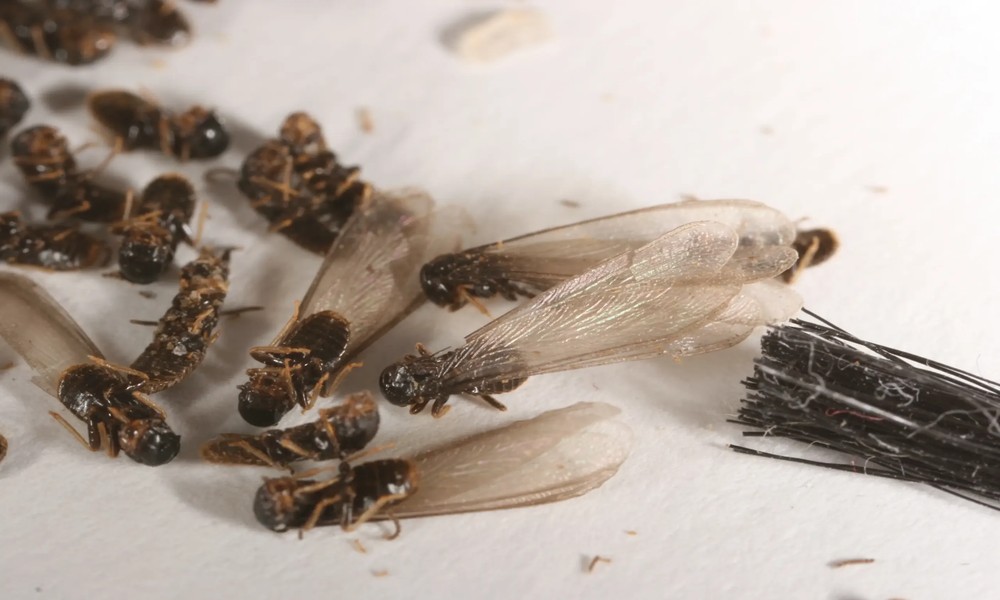
You walk into the laundry room on a warm afternoon and find a handful of small translucent wings scattered on the windowsill. The bugs that left them are nowhere in sight. By tomorrow you’ve forgotten about it. Six months later a contractor opens a wall during a kitchen remodel and finds it riddled with termite damage. Calls like that come into Main Sail Pest Control every spring and fall from homeowners across Lake Elsinore, Murrieta, Wildomar, Menifee, Canyon Lake, and Temecula, almost always with the same regret: they saw the wings and didn’t act.
The Inland Empire sits in one of the few regions in the country that gets active swarms from two distinct termite groups in two different seasons. Knowing which one you’re looking at decides what comes next.
Why the Inland Empire Gets a Double Swarmer Season
Two termite species drive the bulk of structural damage in southwest Riverside County.
The western subterranean termite (Reticulitermes hesperus) lives in colonies of hundreds of thousands to millions, nests in soil, and reaches wood through mud tubes. Reproductives swarm during daylight in late winter and spring, usually within a day or two after a meaningful rain. Warm temperatures, moist soil, and dropping barometric pressure all line up to trigger the flight.
The western drywood termite (Incisitermes minor) lives entirely inside dry wood with no soil contact. Colonies are much smaller, typically a few hundred to a few thousand individuals, and a single home can host several of them in different boards. Drywood reproductives swarm during daylight in late summer and into fall, with peak activity in southern California falling between September and November during hot, dry weather.
Lake Elsinore’s climate is hospitable to both. Spring rains feed the subterranean cycle. The long, dry summer and warm fall feed the drywood cycle. A homeowner who paid attention only to the spring swarm could easily miss a drywood infestation already established in the attic.
How to Tell a Subterranean Swarmer from a Drywood Swarmer
Both species produce winged reproductives with two pairs of wings of roughly equal length. The wings detach easily, which is why finding loose wings on a windowsill is often the first clue that a swarm happened nearby. The differences worth knowing:
- A subterranean swarmer (Reticulitermes) is small. Body length runs around a quarter inch. The body is dark brown to nearly black. Each wing is roughly the same length as the body or slightly longer.
- A drywood swarmer (Incisitermes) is larger. Body length runs closer to a half inch. The body is reddish brown with a darker head. The wings are noticeably larger and have a more visible vein pattern near the leading edge.
Size and color together usually settle it. A swarmer the size of a small fly is subterranean. A swarmer that’s clearly bigger and rusty-colored is drywood.
The location of the wings on the property tells you something, too. Subterranean swarmers often emerge from the ground or from cracks in slab and foundation, then fly toward windows and light. Drywood swarmers emerge from inside the wood itself, often from attics, eaves, window frames, and door casings, and end up fluttering near interior light fixtures and skylights.
Don’t sweep up the wings before taking a phone photo and saving a few in a sandwich bag. A pest technician can ID the species in seconds from a clear image of a wing.
Mud Tubes vs. Frass: The Two Different Calling Cards
Once you have a guess at the species, the supporting evidence on the structure should match.
For subterranean termites, the signature is the mud tube. These are pencil-thick brown earthen tunnels the workers build to travel from soil to wood while staying protected from light and dry air. Look at the foundation perimeter, the inside of the garage at the slab edge, the crawl space if you have one, and any spot where wood meets concrete. Tubes are often built up the inside of stem walls and around plumbing penetrations. Knock one open with a screwdriver. If it has live workers inside or it’s repaired within a few days, the colony is active.
For drywood termites, the signature is frass. Drywood pellets are tiny, about 1 millimeter long, and have six flat sides with subtle longitudinal ridges. They fall out of small kick-out holes that the termites use to push waste out of their galleries. Frass piles look like little heaps of coarse coffee grounds or sand and tend to accumulate on window sills, in attic insulation, on garage floors below ceiling joists, and on shelves below built-in cabinets. The pellets vary in color depending on the wood being eaten.
Mud tubes mean subterranean. Frass means drywood. Finding both on the same property is uncommon but not rare in older Inland Empire homes.
What Main Sail Pest Control Looks For During an Inspection
A real termite inspection takes more than a flashlight and a guess. Trained eyes look for evidence the homeowner won’t see.
A typical inspection covers:
- The full foundation perimeter, looking for mud tubes, soil-to-wood contact, and grade issues that bring soil up to siding
- The garage, including the slab joint, the area behind storage, and ceiling joists in attached garages
- Attic spaces, with attention to rafters, ridge boards, and the wood framing around vents and skylights
- Window and door frames, especially on south- and west-facing walls that bake in the afternoon sun
- Eaves and fascia boards
- Bathroom subfloors and the wood framing around tubs and toilets, where slow leaks can support subterranean termites
- Crawl spaces and the underside of decks and patio covers
- Stored firewood, fence posts, and tree stumps within several feet of the house
The inspection report identifies the species when evidence is present, locates known infested areas, and flags conditions that put the structure at higher risk going forward. In California, termite inspections are governed by the Structural Pest Control Board and are required during most real estate transactions. A free homeowner inspection isn’t the same as the formal Wood Destroying Pests and Organisms (WDPO) report, but it’s the right first step when you’ve spotted swarmers.
What to Do This Afternoon If You Found Wings
A few simple steps protect the evidence and the timeline.
Photograph the wings in place before they get disturbed. Save a few wings and any whole insects in a small container. Note the date, the room, and where the wings were concentrated. Walk the perimeter and the garage looking for mud tubes. Walk through the attic if it’s accessible and look for frass piles and dropped wings near roof penetrations. Check the windowsills throughout the house, not just the room where you first noticed something.
Then call a licensed pest professional for an inspection while the colony is still actively swarming. Wings on a windowsill in March mean the subterranean colony is producing reproductives now. Wings on a windowsill in October mean a drywood colony is in or on the structure. The earlier the inspection, the smaller the affected area is likely to be, and the more options exist for treatment short of whole-structure fumigation.
The team at Main Sail Pest Control schedules termite inspections across Lake Elsinore and the surrounding southwest Riverside County communities. Reach out today to book an appointment before the wings on the windowsill turn into damage in the wall.