

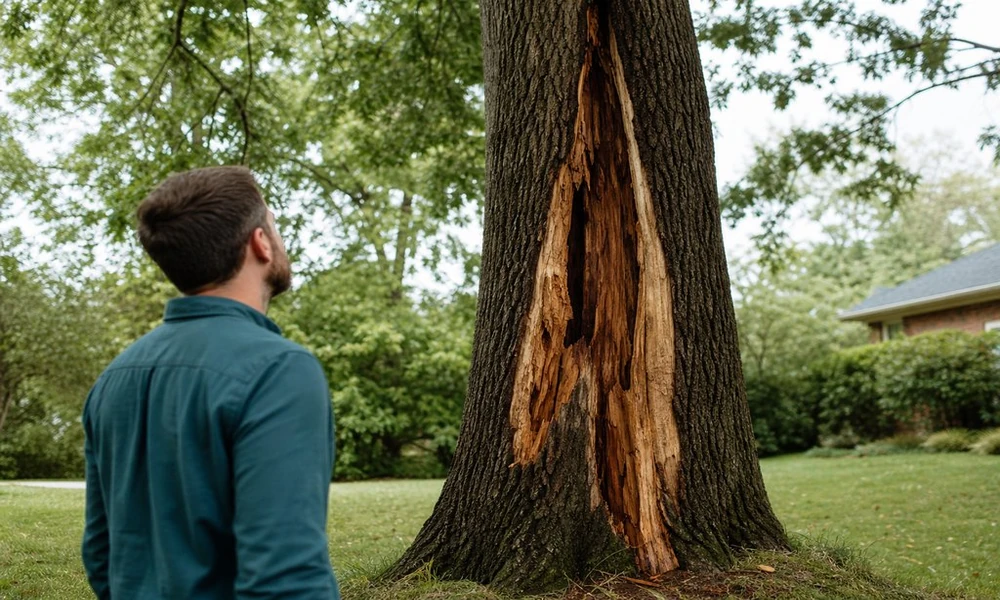
Often, a large, mature tree can give your home and property character and curb appeal. However, as a tree ages or is damaged, it can pose a threat to your home, pets, family, and outdoor living spaces. That’s when it’s important to consider having the tree professionally removed.
Before you schedule tree removal, learn how to evaluate your tree’s health and whether removal is truly necessary.
Canopy Warning Signs
Falling leaves and dying branches can be normal. However, excessive dying branches or foliage can be a sign of poor tree health. Inspect your tree’s foliage and upper branches for:
- Large dead branches (dead branches have no buds or foliage and the smaller twigs are stiff instead of bendable)
- Excessive brown, yellow, or smaller-than-usual leaves (unless it’s normal for your tree to lose its leaves at that time of year)
- Sparse areas on only one side of the tree
- Damaged or dead branches hanging over your home or walkways
- Rubbing or crossing branches
- Recently fallen branches (such as after a storm)
If your tree exhibits one or more of these symptoms, you may need to call a professional to perform pruning or other services. If only a few branches are affected and the rest of the tree appears healthy, you may be able to save it. However, if a large portion of the tree is affected, there may be an issue deeper in the tree that cannot be fixed.
Trunk and Root Damage
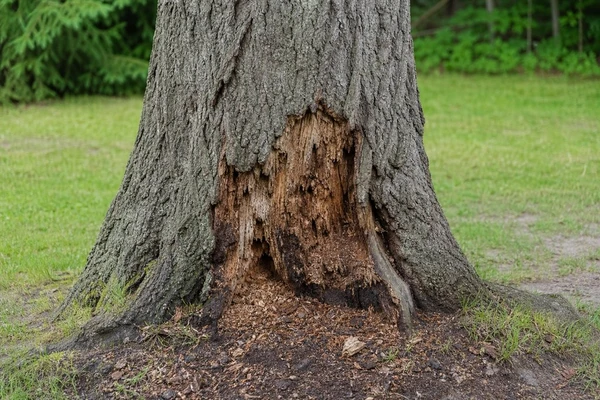
Trunk Inspection
Next, inspect your tree’s trunk for:
- Fungi or mushrooms growing on the trunk
- Bark that is falling off
- Large vertical splits in the trunk
- Large vertical splits where two trunks or branches connect
- Decay or hollowing of the trunk
- Recent leaning of the trunk
- Exposed roots on one side of the tree or lifted soil around the base of the tree
Trees with two main trunks (also called co-dominant trees) can be problematic because they’re more likely to split at the point where the trunks connect, especially if there’s included bark at the connection point.
While fungi growing out of a tree trunk doesn’t necessarily mean that your tree is in danger of falling, it’s a sign that there may be decay within the trunk.
Likewise, while some trees may have a slight lean that’s been there for years without issue, a recent lean can indicate that the root ball is shifting. If this shift continues, your tree could topple over. Consider what’s underneath the tree and how much room the tree has to fall.
Root Zone
Finally, inspect the area around your tree’s base for:
- Exposed roots
- Heaved or cracked soil
- Buried root flare (the area where the trunk meets the roots)
- Soggy soil or standing water
- Decay, insects, or other signs of poor health at the base of the tree
- Evidence of recent digging or root cutting
Sometimes, poor tree health starts from the ground up. If the soil around your tree has been compacted, excavated, or filled in; drainage has changed; or the roots have been damaged or cut, your tree could start to show symptoms of poor health. Symptoms of root loss or damage include sparse foliage, dead branches, and an unstable tree. These symptoms may not appear for months or even years after trenching, excavation, or other root damage.
While mulch can help retain moisture and protect your tree’s roots, avoid allowing mulch to build up against the trunk of the tree. This can retain too much moisture against the bark of the tree and can obscure warning signs of poor tree health.
Site and Fall Risk
As you assess your tree’s health, also consider what’s underneath it. A tree that’s starting to decline in an open area presents a very different situation than a tree that’s leaning over your home, driveway, fence, children’s play area, or power lines.
Saving or Removing
In some cases, poor tree health can be corrected with pruning or other tree care. That decision draws on a tree health assessment of the visible defects and their extent. Pruning can help remove dead branches, relieve stress on the tree by removing some weight from overly long branches, and increase clearance between the tree and your home. Some diseases and insects can also be addressed if caught early enough.
It’s best to have a tree service professional make that call. An experienced arborist can evaluate hard-to-see problem areas, tell the difference between aesthetic and structural bark damage, and evaluate decay, cavities, and branch connections.
Seasonal Monitoring
Walking around your yard each season and noting the condition of your trees can help you address tree care needs before they become emergencies. Pay particular attention to changes in canopy density, the condition of the trunk, and the condition of the soil around the base of the tree.
Taking photos can also help you monitor changes over time, particularly after construction on your property or the extreme weather covered by the IPCC at www.ipcc.ch/report/ar6/wg1/chapter/chapter-11. If you do notice dead branches hanging over walkways, leaning, cracking, or other signs of poor tree health, keep people and vehicles away from the area and schedule an on-site evaluation with a tree service professional.