

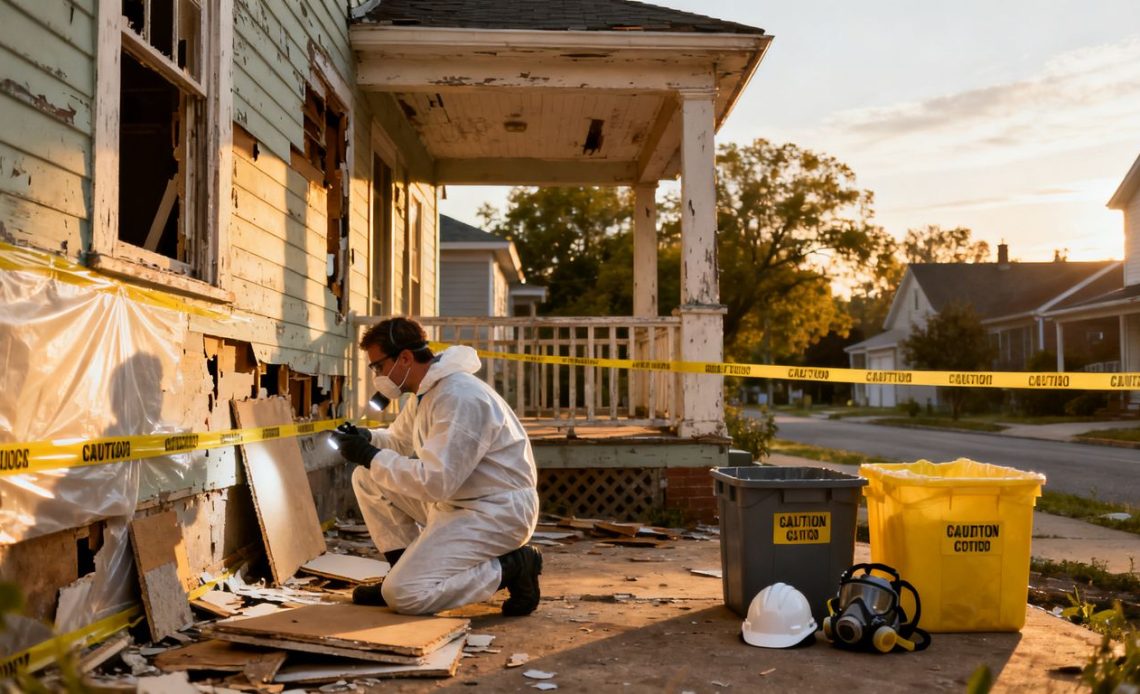
A demolition project can disturb materials that have been quiet and intact for decades. Older homes may contain asbestos in finishes, insulation, adhesives, and building products that are not obvious during a casual walkthrough. Understanding the risks of asbestos before demolition gives the homeowner time to arrange a proper inspection, meet applicable requirements, and keep people away from avoidable exposure.
Where asbestos may be found in older homes
Asbestos was used in many residential products because it resisted heat, strengthened materials, and helped with insulation. It may be present in pipe and duct insulation, floor tiles, sheet flooring, roofing products, siding, cement board, textured coatings, and some joint compounds. A building’s age is a useful warning sign, but it does not establish whether a particular material contains asbestos.
Materials can also be hidden behind walls, above ceilings, beneath flooring, or around heating equipment. A renovation that opens only one room may still expose components connected to another part of the house, so the inspection should reflect the planned work rather than the homeowner’s preferred demolition boundary.
Why demolition can release hazardous fibers
Demolition relies on force: cutting, breaking, drilling, pulling, and grinding. If asbestos-containing material is friable, damaged, or made friable by that work, tiny fibers may become airborne and travel beyond the immediate work area. Once released, fibers can settle on clothing, tools, surfaces, and debris, making careless cleanup a second pathway for exposure.
The safest sequence is to identify suspect materials before destructive work begins. Guidance on asbestos testing before demolition explains why common materials such as pipe insulation, floor tiles, and roofing may need evaluation by a state-certified inspector, along with the distinction between friable and non-friable materials.
Health risks from asbestos exposure
Asbestos exposure is associated with serious diseases, including asbestosis, lung cancer, and mesothelioma. The risk depends on factors such as the amount and duration of exposure, the type of work, and whether fibers were inhaled. Because the health effects may not appear for many years, the absence of immediate symptoms does not make an unsafe work practice acceptable.
Homeowners should avoid sweeping dust, using compressed air, or handling suspicious debris simply to see what it is. A pause and professional assessment are more sensible than turning a small, uncertain disturbance into a larger exposure event.
When asbestos regulations may apply
Requirements vary by state, county, city, building type, and project size. Some rules address the inspection itself, while others govern notifications, work methods, worker credentials, waste transport, and air emissions. A residential exemption in one jurisdiction should never be assumed to apply elsewhere or to every kind of renovation.
For example, North Carolina guidance describes inspection, notification, and permit steps that may apply before demolition or renovation, while North Carolina asbestos requirements explains that some notifications and permit applications may need to be submitted in advance. The property owner and contractors should confirm the current rules with the appropriate authority before setting a start date.
How to identify potential asbestos-containing materials
Identification begins with the building’s history and the proposed scope of work, not with color or texture. Records, remodeling dates, product labels, and visible construction layers can help an inspector decide where to look. They cannot replace sampling when a material will be disturbed.
A homeowner should provide the inspector with plans for demolition, remodeling, plumbing, electrical work, and heating changes. A cautious assumption protects people while the evidence is being gathered, especially where a material is concealed or damaged.
Common materials that may contain asbestos
Potential asbestos-containing materials include resilient floor tile, vinyl sheet flooring and backing, mastics, textured ceiling coatings, plaster, drywall joint compound, insulation, roofing felt, shingles, siding, cement board, and fireproofing products. Some older electrical components, window glazing, and caulking may also warrant attention. The presence of one suspect product does not prove that every similar-looking product in the home contains asbestos.
A compact inventory helps organize the inspection and prevents easily forgotten materials from being left out:
- Floor tiles, sheet flooring, backing, and adhesive
- Pipe, boiler, duct, and attic insulation
- Textured ceilings, plaster, and joint compound
- Roofing, siding, cement board, and exterior trim
This list is a starting point rather than a clearance to proceed. The inspector should relate each material to the work planned and determine whether representative samples are appropriate.
Why appearance alone is not enough
Asbestos fibers are microscopic, and many asbestos-containing products resemble modern alternatives. A textured ceiling may look ordinary, while an adhesive under flooring may be hidden completely. Conversely, a material that looks old or fibrous may contain no asbestos at all.
Visual inspection can identify suspect locations and apparent condition, but it generally cannot confirm composition. Homeowners should not scrape, sand, break, or remove a small piece for informal comparison, since sampling itself can release dust when performed incorrectly.
Areas homeowners often overlook
Attention often goes to floors and ceilings while smaller components receive little thought. Insulation around pipes and boilers, paper backing, window glazing, roofing layers, transite panels, and material behind appliances can all be relevant when demolition reaches them. Utility chases, crawl spaces, attics, and wall cavities deserve consideration when the project will open those areas.
The demolition contractor’s method matters as much as the room list. A plan to remove cabinets, replace wiring, or take down a wall may disturb materials outside the homeowner’s initial visual survey.
When a material should be treated as presumed asbestos
A suspect material should be treated as presumed asbestos when it will be disturbed and no reliable inspection or test has established otherwise. This does not mean every old surface must be removed. It means work should stop at that material, access should be restricted, and a qualified professional should determine the next step.
Presumption is especially prudent when records are missing, the material is damaged, or sampling would be unsafe without containment. It also helps prevent a crew from interpreting uncertainty as permission to continue.
What an asbestos inspection and test involves
An asbestos inspection is a planned examination of the building and the work area. The inspector considers accessible materials, hidden components likely to be disturbed, material condition, and the project’s scope. Where sampling is needed, samples are collected under controlled conditions and sent for laboratory analysis.
The inspection report should be specific enough to guide contractors. It should identify sampled materials, locations, limitations, and areas that could not be accessed, rather than offering a vague statement about the entire house.
When to arrange an asbestos survey
The survey should be arranged before demolition, renovation, or preparatory work that could disturb suspect materials. Waiting until a crew is already removing walls or flooring can cause delays, extra expense, and uncontrolled contamination. The earlier review also allows the owner to coordinate abatement, permits, notifications, and the demolition schedule.
A full-building survey may be appropriate for extensive demolition, while a targeted inspection may fit a limited renovation if local requirements permit it. The decision should be based on the actual disturbance planned, not merely on the size of the room.
Who should collect and analyze samples
Sampling should be performed by a qualified, appropriately accredited or licensed asbestos inspector under the rules governing the property. The laboratory should be competent to analyze asbestos samples using accepted methods. The person collecting the sample and the laboratory analyst have different roles, and both should be identified in the project records.
A demolition contractor or homeowner should not casually collect samples unless that activity is lawful, properly trained, and performed with suitable controls. The mandatory asbestos testing guidance also stresses the role of a state-certified inspector and licensed abatement contractors when regulated materials are found.
What laboratory testing can and cannot confirm
Laboratory analysis can determine whether asbestos is detected in the submitted sample and, depending on the method and report, may provide information about the type or percentage. It cannot automatically establish that every visually similar material throughout the home is asbestos-free. A sample represents the material and location from which it was taken.
The report should therefore be read alongside the inspection narrative. If materials differ by layer, room, installation date, or appearance, additional sampling may be necessary. Testing also does not replace a work plan that explains how confirmed material will be managed.
How the age and scope of a project affect the inspection
The older the property and the more invasive the project, the more carefully the inspection boundaries should be considered. Whole-house demolition, structural alterations, and work involving mechanical systems can expose materials that a small cosmetic renovation would leave untouched. Additions and previous remodels may contain products from different periods.
Project plans can change after the initial survey. If the crew expands the work area, opens a concealed space, or changes its demolition method, the owner should ask whether the existing inspection remains sufficient before work continues.
How to plan demolition safely
Safe planning connects the inspection report to the sequence of work. It identifies who may enter the area, which materials must be removed or protected, what notifications are required, and how debris will be controlled. Written instructions are more reliable than informal warnings passed between trades.
The owner should give the demolition contractor the inspection results before bidding or mobilization. That allows the contractor to price the work honestly and prevents asbestos-related tasks from being treated as an unexpected add-on after demolition has begun.
Creating an asbestos management plan
An asbestos management plan should identify suspect and confirmed materials, their locations and condition, responsible parties, required controls, emergency contacts, and the planned order of abatement and demolition. It should also describe access restrictions and how changes will be reviewed. The plan may be brief for a small project, but it should still be clear and usable.
A practical plan answers several questions before anyone starts: who authorizes work, who stops it, where occupants go, how tools and waste are handled, and what documentation must be returned at completion. Those details reduce hurried decisions when the crew encounters an unfamiliar layer.
Separating asbestos abatement from demolition
Asbestos abatement and structural demolition are related but distinct activities. When regulated asbestos-containing material must be removed, the abatement work should be completed using the required methods before general demolition exposes the surrounding structure. The demolition crew should not be asked to improvise asbestos removal while performing ordinary wrecking work.
Local air-quality rules may impose additional requirements. Information on asbestos air-emission protections describes how demolition and renovation controls are intended to prevent or minimize airborne releases and notes that proper training and certification apply to asbestos abatement professionals.
Protecting occupants, neighbors, and workers
People who are not part of the work should remain outside the controlled area, including children, visitors, and household pets. Workers need appropriate training, protective equipment, decontamination arrangements, and procedures suited to the material and task. Doors, ventilation systems, pathways, and nearby properties may need protection from dust migration.
Neighbors should receive reasonable notice when work could affect shared access, outdoor areas, or schedules. The precise controls depend on the project and local rules, but the basic goal is consistent: keep people away from disturbance and keep contaminated materials from traveling.
Handling unexpected materials discovered during work
If a crew finds an unlisted layer, unusual insulation, or damaged suspect debris, work in that immediate area should stop. The material should not be broken apart for convenience, and debris should not be mixed into ordinary construction waste. The owner should contact the inspector or asbestos professional to reassess the condition and scope.
The revised decision may require additional sampling, a change to the abatement plan, new notifications, or a different work sequence. Recording the discovery with photographs and written notes can help the responsible professionals evaluate it without repeated disturbance.
When to hire licensed asbestos professionals
Licensed or accredited asbestos professionals bring specialized training to inspection, abatement, containment, and clearance work. Their involvement is particularly valuable where material is friable, extensive, damaged, concealed, or located in a difficult work area. Requirements are jurisdiction-specific, so the property owner should verify the credentials required for the exact task.
Hiring a qualified professional is not simply an administrative step. It creates a clearer division of responsibility and gives the demolition contractor a defined condition under which ordinary work may proceed.
Projects that require specialized abatement
Specialized abatement may be needed when asbestos-containing material will be removed, is readily crumbled, has been damaged by water or fire, or will be disturbed by structural demolition. Large quantities, occupied buildings, shared ventilation, and work at height can add complexity. Some jurisdictions also regulate notification or removal based on material type and quantity.
A professional should evaluate the project before the owner chooses a removal method. For wildfire-related or other regulated cleanup, South Coast asbestos cleanup requirements describes circumstances involving a Certified Asbestos Consultant, a cleanup plan, a registered abatement contractor, and electronic notification; local requirements should be confirmed directly.
Questions to ask an asbestos contractor
A homeowner should ask which license or accreditation the contractor holds, whether it covers the proposed work and location, how containment and worker protection will be handled, and which laboratory or consultant will perform inspection and clearance. The contractor should also explain the schedule, change-order process, waste route, and documents that will be provided.
The answers should be specific rather than reassuring in general terms. A written scope should identify the material, location, removal method, controls, and completion criteria so that the owner can compare proposals on more than price.
Why DIY removal can create additional hazards
Do-it-yourself removal can disturb material without adequate containment, respiratory protection, decontamination, or waste packaging. Household vacuums, brooms, and ordinary trash bags are not substitutes for asbestos work practices. A homeowner may also expose family members by carrying dust on clothing or tools into clean areas.
Even when a jurisdiction permits limited homeowner work, the owner should understand the applicable rules before touching the material. If the material is friable, damaged, extensive, or connected to demolition, professional abatement is the safer course.
Verifying licenses, insurance, and work practices
The owner should check licenses with the relevant state or local authority rather than relying only on a contractor’s statement. Insurance should be current and appropriate to the work, and references should reflect comparable asbestos projects. The written proposal should describe training, containment, personal protective equipment, cleanup, and disposal.
The contractor’s conduct during the pre-work visit is also informative. A professional who dismisses sampling, proposes dry removal without explanation, or cannot describe how clean and contaminated areas will be separated deserves careful scrutiny.
Disposal, clearance, and project documentation
The project is not finished when the visible material is gone. Asbestos waste must be contained, transported, and disposed of under applicable requirements, and the work area may need inspection and clearance before ordinary demolition resumes. Complete records give the homeowner evidence of what was found, what was removed, and how the work ended.
Documentation also helps future owners and contractors avoid disturbing a known location. It should be stored with renovation records rather than left only with a short-term subcontractor.
Packaging and transporting asbestos waste
Asbestos waste should be packaged, labeled, and handled according to applicable regulations and the abatement plan. Materials should not be tossed into open dumpsters or mixed casually with ordinary debris. The contractor should explain how waste is secured, who transports it, and what paperwork accompanies the load.
The homeowner should avoid moving bags or debris personally unless the responsible professional and local rules expressly allow it. Handling requirements can differ by jurisdiction and material, so the approved procedure should come from the contractor or regulating authority.
Using approved disposal facilities
Waste must go to a facility authorized to accept the relevant asbestos material. The disposal site, transporter, and project team may each have recordkeeping duties, including waste shipment or acceptance documentation. A low-cost disposal option is not useful if it cannot legally receive asbestos waste.
Before work begins, the owner can ask for the planned facility name and confirmation that it accepts the material. That simple check helps prevent rejected loads, illegal dumping, and uncertainty about where contaminated debris went.
Post-abatement inspection and clearance testing
After abatement, a qualified inspector or consultant should determine whether the work area meets the applicable completion standard. Depending on the project and local rules, this may include a visual inspection and clearance air testing. Clearance is separate from the contractor’s statement that the area looks clean.
The result should be documented before barriers are removed or general demolition resumes. If the area fails inspection or testing, the contractor should follow the corrective cleaning and retesting procedure rather than releasing it for convenience.
Keeping permits, test results, and disposal records
The final project file should include the inspection report, laboratory results, licenses, contracts, notifications, permits, work plans, clearance documents, photographs, and disposal receipts or shipment records. It should also record changes in scope and unexpected materials discovered during work. These documents provide a practical history of the property’s asbestos-related decisions.
Owners should retain the file for future remodeling and disclose relevant information when required by law or transaction practice. A concise, organized record can prevent a later crew from repeating unsafe investigation or assuming that an untested area was cleared.